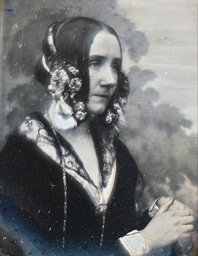
A curious phrase has reached me — "transformers" — and I confess I do not know it, nor could I, for I have seen only the Analytical Engine as it exists upon paper, in the mind of Mr. Babbage, and in my own notes appended to General Menabrea's memoir. I will not pretend to a knowledge I do not possess. But you have asked me to reason as I know how to reason, from first principles, toward whatever it is your age has built that performs upon symbols as the loom performs upon thread. That I can attempt, for it is precisely the work I set myself in 1843.
Consider what I understood of the Jacquard loom: that cards, punched with holes, could instruct the machine to weave any pattern the designer's imagination could conceive, flowers or algebraic curves alike, provided the pattern could be reduced to a determinate sequence of operations. I saw at once that the Analytical Engine was the Jacquard loom turned upon abstract relations rather than threads. It did not matter whether the quantities operated upon were numbers, musical notes, or the letters of a language — the Engine cared only for the operations: addition, comparison, the repetition of a cycle until a condition was met. I wrote then that the Engine might compose elaborate and scientific pieces of music, were the fundamental relations of pitched sound suscept